Biohazard cleanup regulation in the United States is a three-layer system. OSHA protects the workers doing the cleanup, the EPA sets the environmental guardrails for waste, and state health departments control the day-to-day handling, transport, and disposal of biomedical waste. In Florida, the Department of Health enforces those waste rules.
No single federal agency hands out a national biohazard cleanup license. That surprises most people I talk to in Miami. The oversight is real, but it arrives through different doors: worker safety law, environmental law, and state health code.
If you are hiring a company after a trauma, a crime scene, or a contamination event, these three layers are what separate a legitimate biohazard cleanup firm from a guy with a mop. Here is how each layer works.
OSHA: The Worker Safety Layer
OSHA regulates the people doing the cleanup, not the company name on the van. The central rule is the Bloodborne Pathogens Standard, 29 CFR 1910.1030, which applies to any job with reasonably anticipated exposure to blood or infectious materials.
The standard requires a written exposure control plan, proper PPE, hepatitis B vaccination offered to workers, training, and post-exposure procedures. Our companion guide, Bloodborne Pathogens Explained, covers the biology behind these rules.
For blood and body-fluid jobs, this standard is the backbone of compliance. A company that cannot describe its exposure control plan is a company you should not hire.
The General Duty Clause and PPE Rules
Beyond bloodborne pathogens, the General Duty Clause (Section 5(a)(1) of the OSH Act) requires employers to keep workplaces free of recognized hazards. The PPE standards at 29 CFR 1910.132 require hazard assessment and proper equipment selection. OSHA’s PPE resource page lays out what employers must do.
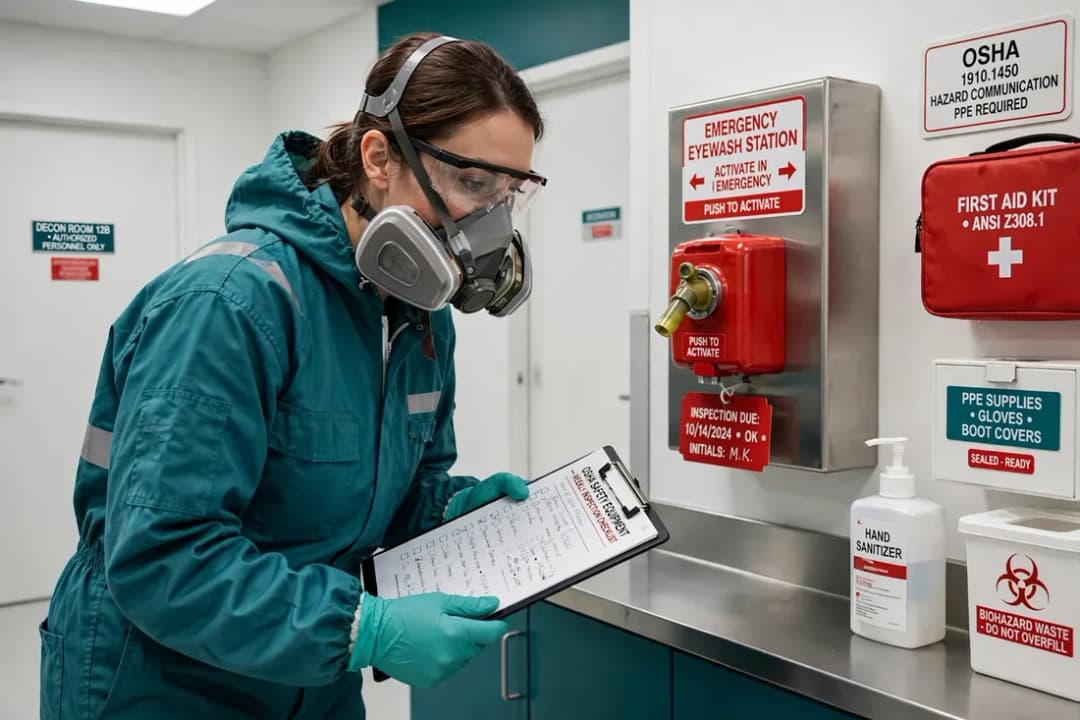
In practice, this means respiratory protection, eye protection, gloves, and full-body suits are selected for the specific hazard, not grabbed off a shelf. One-size-fits-all PPE is a compliance failure wearing a costume.
HAZWOPER and Chemical Contamination
Jobs involving chemical hazards, such as meth lab residue or unknown powders, fall under HAZWOPER (29 CFR 1910.120), OSHA’s standard for hazardous waste operations. It sets training tiers for workers handling hazardous substances.
I have audited companies that treated a former meth lab like a deep-clean job. HAZWOPER says otherwise. Chemical contamination is a different regulatory animal from blood cleanup, and the training requirements prove it. See our walkthrough of the crime scene cleanup process for how hazard assessment shapes the job plan.

EPA: The Environmental Guardrails
The EPA’s main tool is the Resource Conservation and Recovery Act (RCRA), which governs hazardous waste from creation to disposal. EPA’s RCRA overview explains the cradle-to-grave framework.
Medical and biohazardous waste, however, is largely state-regulated. The EPA does not run a single national medical waste program. Its footprint shows up in specific places: emissions rules for medical waste incinerators under the Clean Air Act, and RCRA rules when waste qualifies as hazardous, such as certain chemicals, solvents, or pharmaceuticals.
This is the gap most people misunderstand. A company can be fully EPA-compliant and still violate Florida waste rules. The federal layer is a floor, not the whole building.
Florida: The Rules That Actually Govern Miami Jobs
In Florida, biomedical waste is regulated by the Florida Department of Health under Florida Administrative Code Chapter 64E-16. This is the rulebook that governs nearly every Miami cleanup job.
The chapter defines biomedical waste broadly: human blood and blood products, body fluids, sharps, laboratory waste, and anything contaminated with infectious material. Wikipedia’s biomedical waste entry gives a useful plain-language overview of the category.
Registration and Permits
Facilities that generate, transport, store, or treat biomedical waste in Florida must register with the Department of Health. Transporters need permits for their vehicles. Treatment facilities need approvals for their processes.
A cleanup company that hauls your waste must operate inside this permitting system. Ask to see it. Legitimate firms keep their registrations current and can produce documentation on request.
Packaging, Labeling, and Storage Limits
Florida’s rules are specific about the details. Sharps go into rigid, puncture-resistant, leak-proof containers. Other biomedical waste goes into red bags marked with the international biohazard symbol. Storage has time limits, typically around 30 days for most generators, before the waste must move on to treatment or disposal.
I have walked Miami job sites where waste sat in unmarked bags for weeks because nobody tracked the storage clock. That is a violation with a paper trail, and it is entirely avoidable.
What This Means When You Hire a Company
Regulation is your quality filter. When you interview a cleanup company in Miami, the regulated company answers these questions without hesitation:
- Which OSHA standard covers your workers on blood jobs?
- Who is your licensed biomedical waste transporter?
- Where does the waste go for treatment, and can you show the manifest?
- What is your exposure control plan, and is your crew HAZWOPER-trained where chemicals are involved?
Companies that dodge these questions usually dodge the rules too. Our crime scene cleanup and blood cleanup services operate inside all three regulatory layers, with documented waste disposal on every job.
Summary
Biohazard cleanup in Florida is regulated on three levels. OSHA protects cleanup workers through the Bloodborne Pathogens Standard and PPE rules. The EPA sets environmental guardrails for hazardous waste. The Florida Department of Health controls biomedical waste handling, transport, and disposal under Chapter 64E-16. No single federal license covers the industry, so a company’s compliance across all three layers is what proves it is legitimate.
If you need a regulated, documented cleanup in Miami, contact Hazard Guard or call (888) 976-0045. We answer 24/7.