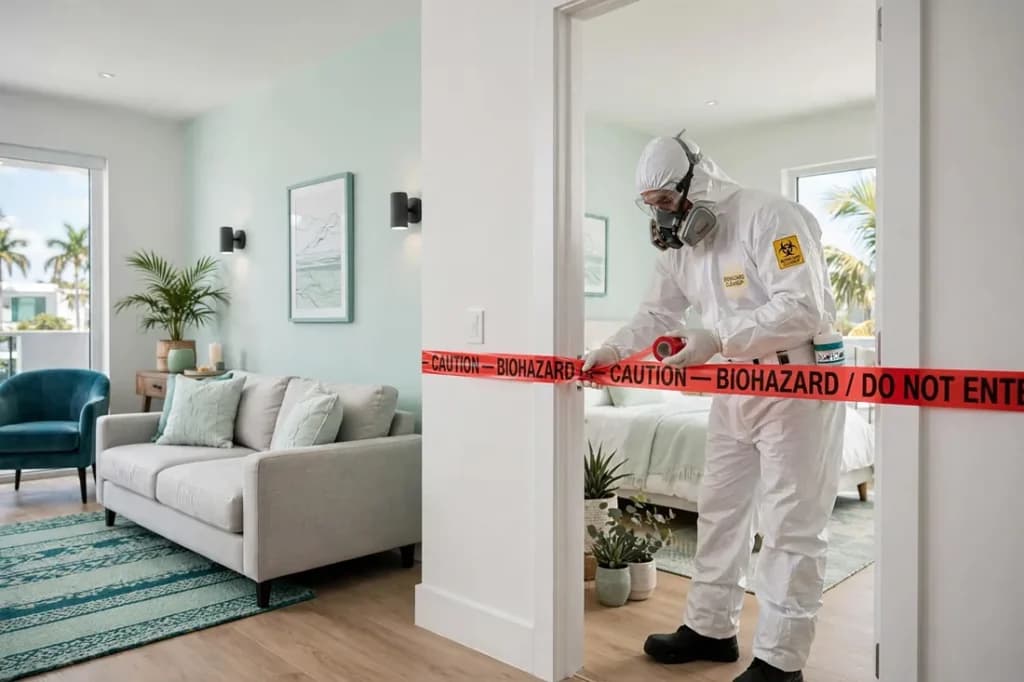
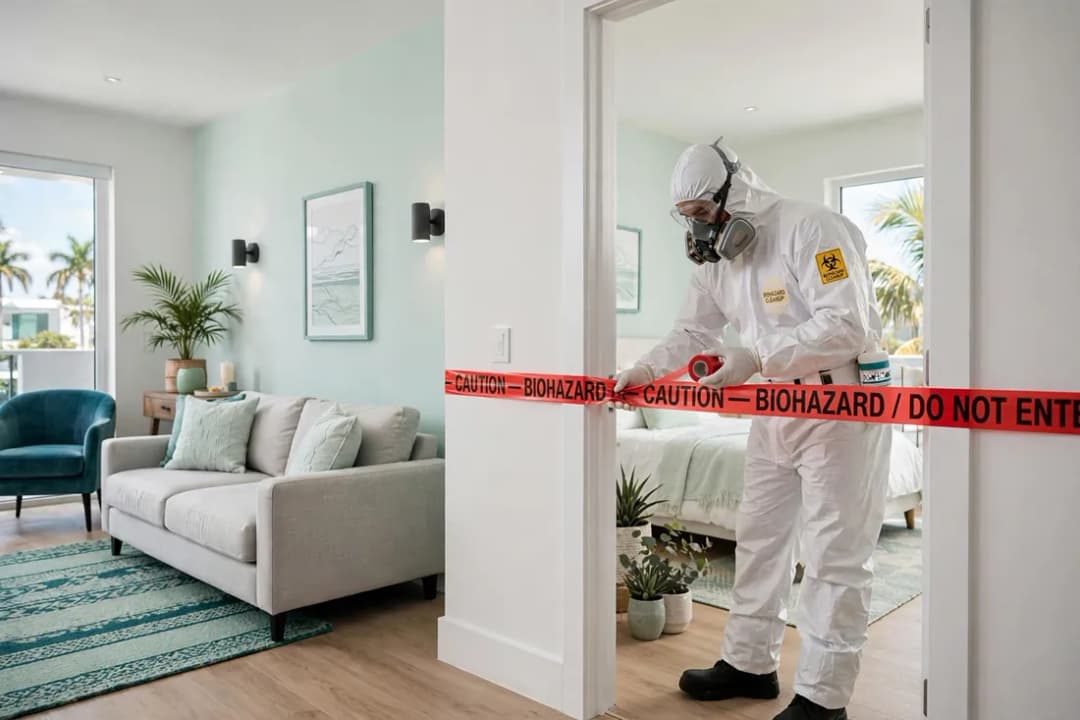
Your first response after discovering a biohazard at home is to stop, isolate the area, and not touch anything. The correct sequence is people first, then containment, then documentation, then a professional cleanup crew. What you do in the first ten minutes matters more than anything that follows.
That sequence sounds simple. It is the one most people get wrong, because panic and the urge to “just clean it up” kick in fast.
Step 1: Stop and Assess From a Safe Distance
Your first move is no move. Do not step into the affected area. Do not touch anything. Stand at a safe distance and take in what you are looking at.
The scene may involve blood, bodily fluids, sewage, or decomposition. Treat all of it as infectious until a professional says otherwise. The CDC documents that bloodborne pathogens like hepatitis B, hepatitis C, and HIV can survive outside the body in dried blood for days to weeks.
I have walked into Miami homes where a well-meaning family member already tracked material through three rooms in the first five minutes. One pair of sandals turned a one-room problem into a whole-house job. Flip-flops and panic are the two most common multipliers I see.
Step 2: Get People and Pets Out of the Area
Move everyone, including pets, out of the affected room and shut the door. Children and elderly family members go first. If the situation is in a shared hallway or living space, move everyone to another floor or another room with the door closed.
Do not wait to do this politely. A closed door is the cheapest containment tool you own. Use it.
In Miami condos this step also protects your neighbors and your HOA standing. Most condo associations have rules about reporting hazards that affect common areas. Keeping the area closed gives you time to figure out those obligations without the problem spreading into a hallway or elevator.
Step 3: Do Not Run the HVAC, and Ventilate Only if Safe
Turn off your HVAC system if the contamination could be airborne or near a return vent. Your air handler recirculates whatever is in the air through the whole house. In a Florida home, that can carry contamination into every room in minutes.
This is the step almost everyone gets backwards. People open every window and crank the air conditioner to “air it out.” If the contamination is near a return vent, that AC just became a distribution system.
Ventilate with a window only if you can do it without walking through the scene. One window, one room, no cross-breeze through clean areas. After a sewage backup during hurricane season, ventilating also reduces the moisture load that accelerates bacterial growth in Miami heat.
Step 4: Document the Scene With Photos
Take photos from outside the affected area. Capture the extent of what you can see without entering. These photos do three jobs.
First, they help a cleanup crew scope the job before we arrive, which shortens response time. Second, they support any insurance claim you file later. Third, they give you a record if the situation turns into a landlord or HOA dispute.
Take wide shots and a few close ones. Do not stage or clean anything before photographing. Adjusters want to see the scene as found.
Step 5: Resist the Urge to Clean It Yourself
This is the hardest step. Do nothing. Household cleaning on a biohazard scene makes the outcome worse, not better.
The single most common mistake I review on Miami jobs is the bleach-and-mop response. Someone pours bleach on a blood spill and mops it around. The bleach needs wet contact time, usually 3 to 10 minutes on the label, to kill pathogens. Mopping spreads it thin across a wider area while the active ingredient evaporates. You end up with a bigger contaminated footprint and a false sense of safety.
The second most common mistake is scrubbing. Aggressive scrubbing aerosolizes dried material. What a professional notices, and a homeowner never does, is that dried blood and bodily fluids become airborne when disturbed. You cannot see that happening. Neither does your family in the next room.
If the scene involves a trauma situation, cleanup is also legally the property owner’s responsibility once law enforcement releases the scene. Police document the scene. They do not clean it.
Step 6: Call a Professional Biohazard Cleanup Crew
Once the area is isolated and documented, call a professional crew. Look for a company that is IICRC-certified, follows OSHA’s Bloodborne Pathogens Standard (29 CFR 1910.1030), and carries a documented exposure control plan.
Ask three things before you hire: are your technicians trained under an exposure control plan, do you use EPA-registered disinfectants with documented dwell times, and does a licensed transporter handle the waste. Any company that cannot answer all three is not ready for your job.
Hazard Guard’s biohazard cleanup team in Miami answers 24/7. In most of Miami-Dade County, crews arrive within the hour. Cleanup is regulated under federal and state law, and the company that handles your waste must document the full disposal chain. You can read who regulates biohazard cleanup and how the waste disposal chain works before you decide.
Miami-Specific Factors That Change Your First Response
Miami conditions make fast action matter more, not less. Heat and humidity accelerate decomposition and bacterial growth. A scene that can wait an hour in winter elsewhere cannot wait the same way here in October. Odor sets into porous materials faster, and it becomes harder to remediate the longer it sits.
Hurricane season adds another wrinkle. Sewage backups and floodwater are classified as Category 3 water by the IICRC, meaning grossly contaminated. After heavy rain events, what looks like “just water” in a ground-floor unit can carry sewage. Treat it as a biohazard until tested.
What Not to Do: The Short List
Keep this list on the fridge, if you keep anything:
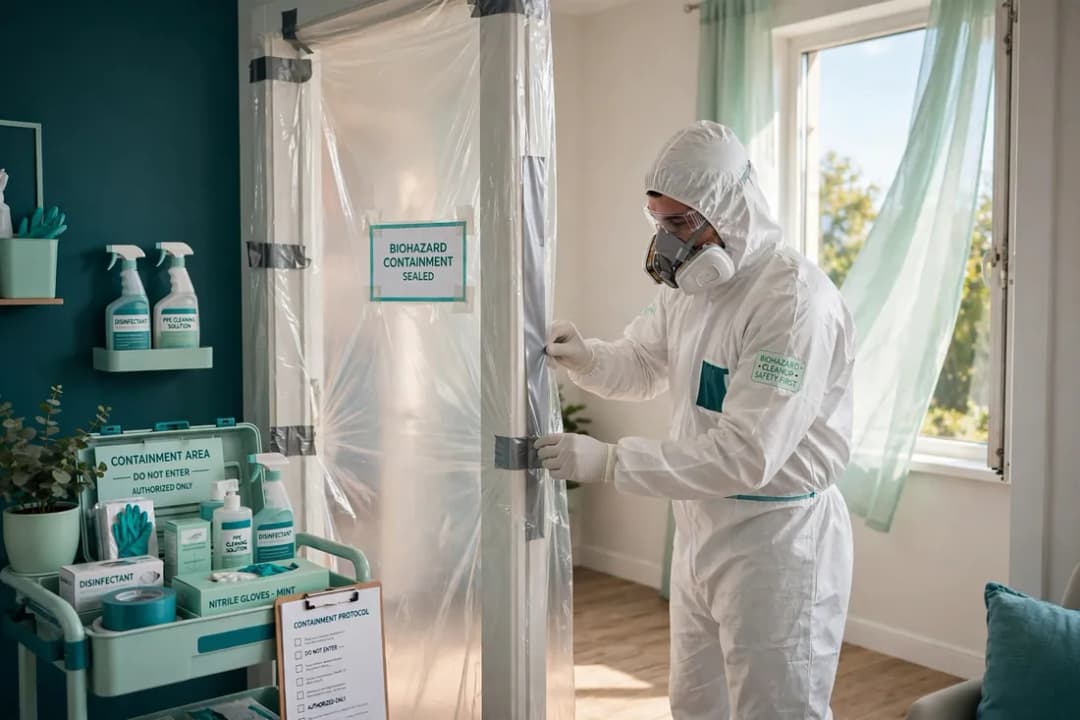
- Do not touch the material with bare hands, and do not assume gloves from under the sink are enough
- Do not use household bleach as a shortcut; disinfection requires specific products, dilutions, and contact times
- Do not put contaminated materials in your regular trash; biomedical waste has a regulated disposal chain
- Do not run fans or the HVAC through the affected area
- Do not enter the scene to “take a closer look”
Summary
Discovering a biohazard at home calls for restraint first. Isolate the area, keep people and pets out, keep the HVAC off, document from a distance, and do not attempt to clean it yourself. Then call a trained, certified crew that follows OSHA protocols.
Miami heat and humidity mean every hour of delay raises the remediation cost and the health risk. If you need help now, contact Hazard Guard or call (888) 976-0045. Our crews respond across Miami-Dade 24/7.