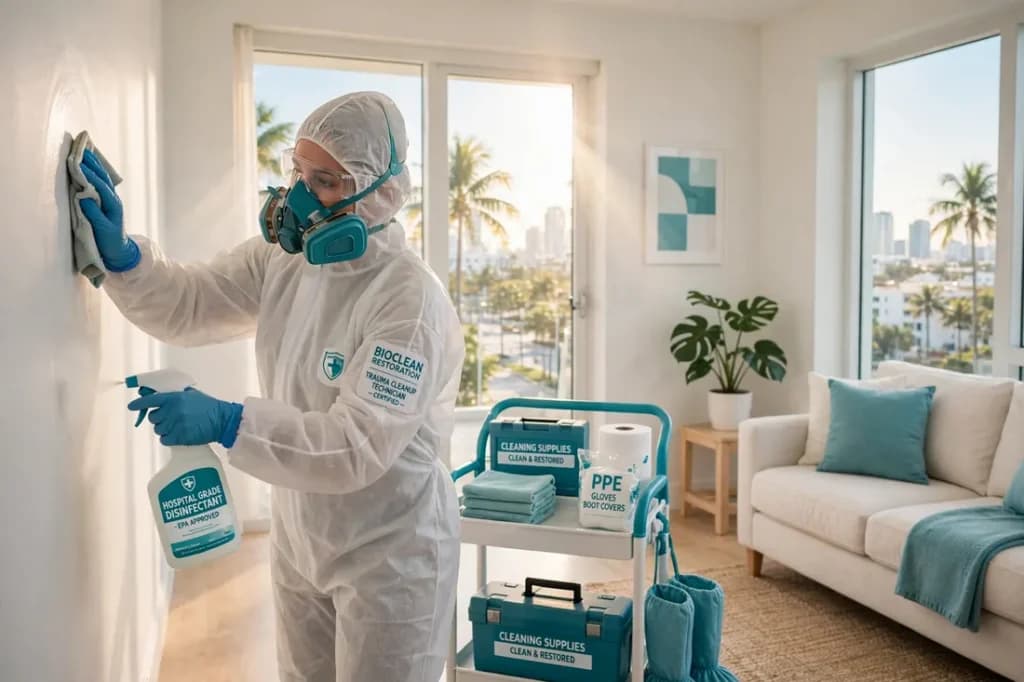
Trauma cleanup handles accidental injuries, suicides, and unattended deaths with no criminal investigation attached. Crime scene cleanup handles scenes under active or potential criminal investigation, where law enforcement controls access and evidence rules apply.
The decontamination craft is nearly identical. The legal context, timing, and coordination are not.
Here is how they differ, what stays the same, and why the distinction matters for property owners in Miami.
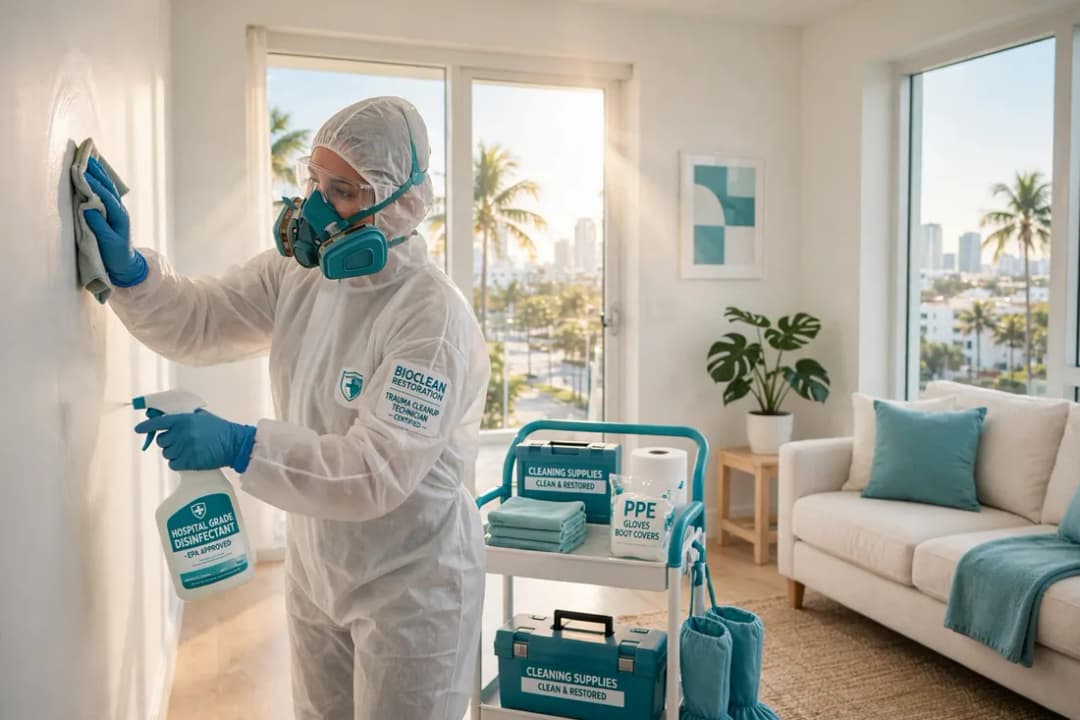
The Core Difference: Investigation Status
This is the dividing line. Everything else flows from it.
A crime scene is a potential evidence repository. Law enforcement secures it, investigators process it, and nobody enters until the scene is formally released.
Cleanup before release is obstruction, not helpfulness.
A trauma scene has no such restriction. Once medical examiners and first responders clear it, a family member or property owner can authorize trauma cleanup immediately.
No release paperwork, no evidence chain.
The physical work looks the same. The permission structure does not.
7 Differences That Matter in Practice
1. Timing and Access
Crime scenes wait on law enforcement. Release can take hours or days depending on the investigation.
Our crime scene cleanup crews stage nearby and mobilize the moment the release comes through. Our guide on police release timing covers that process step by step.
Trauma scenes move on the family’s timeline. We have started trauma cleanups within an hour of the first call.
Nobody is waiting on a detective.
2. Who Authorizes the Work
For crime scenes, the property owner or legal occupant authorizes cleanup after release. Police do not hire the crew and do not clean the scene themselves.
For trauma scenes, whoever controls the property authorizes it: the homeowner, a family member, a landlord, or an estate executor. Our responsibility breakdown explains how this works for both scene types.
3. Evidence Preservation Rules
On crime scenes, crews must not disturb anything until release. After release, the rule relaxes, but we still document everything photographically before touching it.
If an investigator missed something, our photos become the record.
On trauma scenes, no evidence rules apply. The work is purely remediation.
4. Documentation Requirements
Both scene types get full photographic documentation. But crime scene jobs often need an extra layer: chain-of-custody awareness, timestamped images, and sometimes coordination notes for attorneys or insurers.
Trauma documentation focuses on scope, before/after condition, and the invoice trail for insurance claims.
5. Emotional Handling
Trauma scenes frequently involve the family directly. Unattended deaths and suicides mean grieving people are making decisions in real time.
The crew’s demeanor matters as much as its technique.
Crime scenes can be equally emotional, but the family is often not present during the work. The interaction is more procedural: updates to the owner, coordination with detectives, written timelines.
6. Insurance and Payment Paths
Both types can be covered by homeowners insurance or victim assistance programs. But crime scenes unlock specific funding: Florida victim compensation funds can cover cleanup costs for qualifying violent crimes.
Trauma scenes rely on standard property insurance or out-of-pocket payment. The victim assistance angle is worth reading if a crime scene is involved.
7. Odor and Decomposition Profiles
Crime scenes are often discovered fast because someone called 911. Trauma scenes, especially unattended deaths, can sit undiscovered for days or weeks in Miami heat.
Decomposition changes the job completely. Odor remediation, subfloor assessment, and HVAC decontamination all scale with time undiscovered.
An unattended death after ten days in August is a fundamentally bigger job than a fresh scene, regardless of category.
What Stays Identical in Both
The remediation craft does not change. Both scene types get the same six-step sequence: assessment, containment, removal of contaminated materials, EPA-registered disinfection with proper dwell time, deodorization, and regulated medical-waste disposal.
Both follow OSHA’s Bloodborne Pathogens Standard. Both require the same PPE. Both end with verification that the space is safe.
The difference is never the cleaning. It is the context around the cleaning.
A Common Mistake Miami Property Owners Make
Here is what I see constantly. An owner hears “crime scene” and assumes police will handle cleanup.
They do not. Law enforcement investigates and releases, then leaves. The physical scene is the owner’s responsibility.
The other mistake runs the opposite direction. An owner treats a trauma scene casually, assumes it is a deep clean, and sends the regular cleaning crew.
Regular cleaners have no PPE, no bloodborne pathogen training, and no legal way to dispose of the waste. That is how contamination spreads and liability grows.
Know which scene you have. Then hire accordingly.
Summary
Trauma cleanup and crime scene cleanup use the same decontamination craft, but they differ in seven practical ways: investigation status, timing and access, who authorizes the work, evidence rules, documentation depth, emotional handling, and payment paths. Decomposition timelines can make a trauma job larger than a fresh crime scene.
If law enforcement is involved, wait for formal release, then call a professional crew. If it is a trauma scene, call as soon as you are ready.
Either way, do not send a regular cleaning crew.
Need help in Miami? Contact Hazard Guard or call (888) 976-0045. We handle both scene types across Miami-Dade, 24/7.