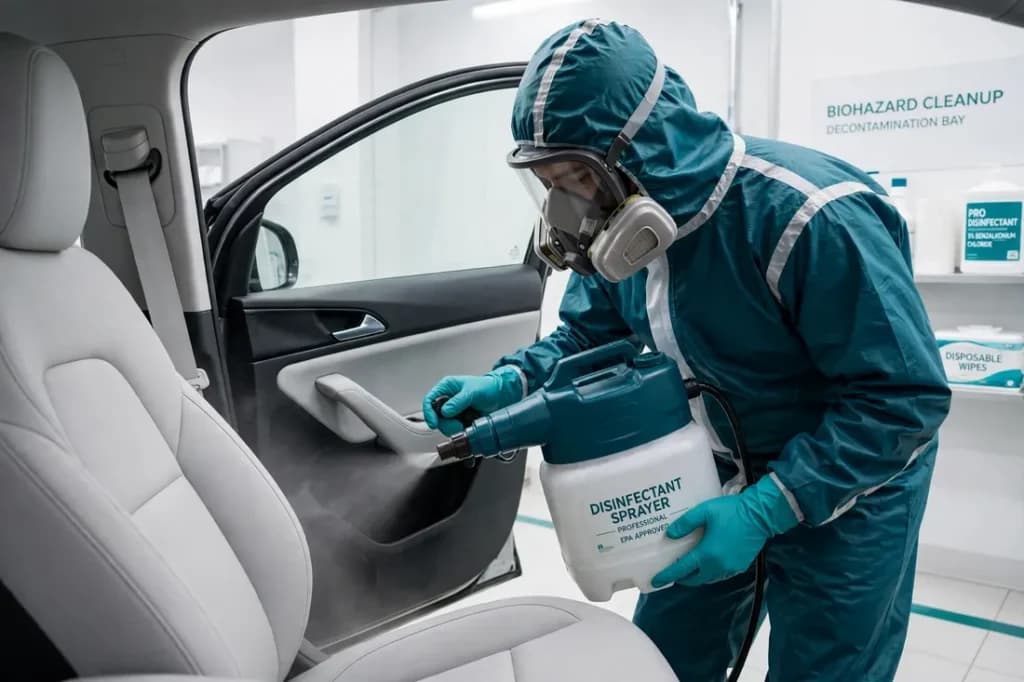
Vehicle biohazard cleanup is the professional removal, disinfection, and lawful disposal of blood, bodily fluids, and other biological hazards from a car, van, truck, or fleet vehicle, carried out by trained crews using EPA-registered disinfectants and full protective equipment. It restores the vehicle to a safe, usable condition, and it protects the next driver, passenger, or technician who touches it.
A vehicle is a small, sealed space, and that makes contamination harder to manage than a room. Heat, upholstery, air vents, and electronics all trap what the eye cannot see.
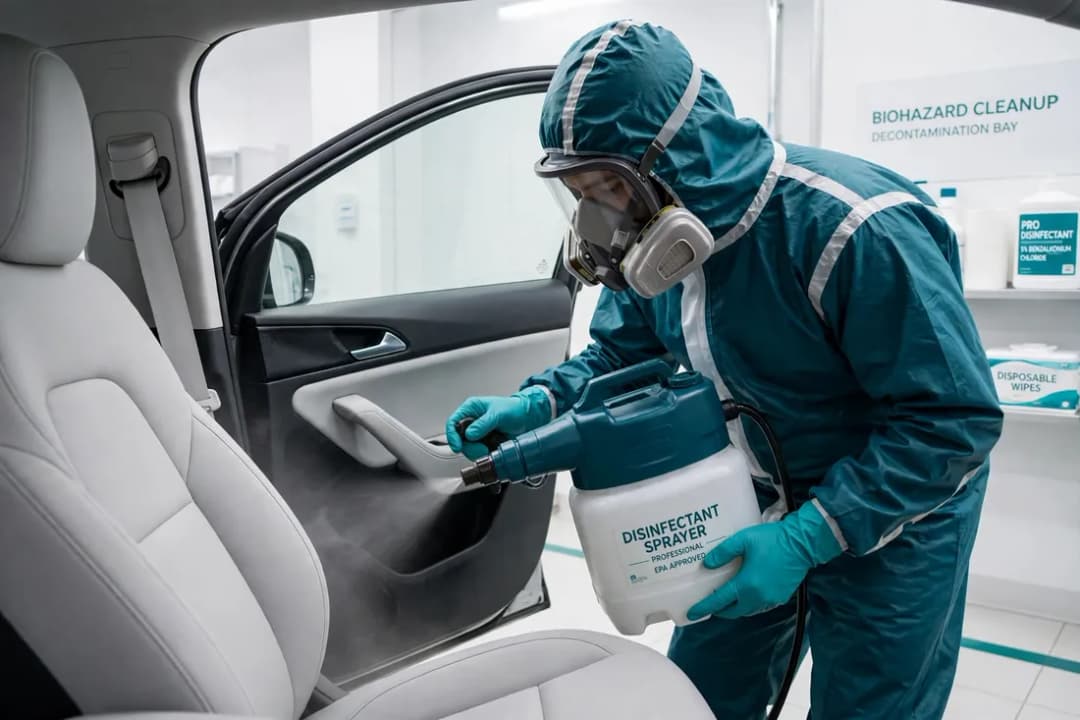
Vehicle Contamination Is Different From Room Contamination
A car interior is mostly porous material. Seats, headliners, carpet, and seat belts absorb fluids fast, and they release odor slowly.
Hard trim looks easy to wipe, but seams, stitching, and air vents hide contamination. In Miami heat, a closed vehicle can reach extreme temperatures in an hour, and that accelerates odor and bacterial growth.
I have assessed cars where the visible stain was a handprint on a door panel, and the real problem was fluid that had wicked into the seat foam beneath it. The panel wiped clean in minutes. The seat needed removal.
Situations That Need Professional Vehicle Decontamination
Professional help is needed when any of these are present in a vehicle:
- Blood or bodily fluids from an injury, medical emergency, or death in the vehicle
- A crime scene or trauma scene inside a car, van, or truck
- An unattended death discovered in a vehicle
- Drug residue, including fentanyl or methamphetamine, in a work or rental vehicle
- Sewage, vomit, or animal waste that has soaked into upholstery or carpet
- Any contamination in a fleet, rental, rideshare, or work vehicle that will carry other people
The common thread is risk to the next person. If bloodborne pathogens may be present, such as hepatitis B, hepatitis C, or HIV, as documented by the CDC, the vehicle is not a DIY job.
The Vehicle Decontamination Process Step by Step
Every professional vehicle job follows a documented sequence, adapted from our biohazard cleanup service in Miami.
Assessment and Containment
We inspect every surface, including under seats, inside door pockets, and around the trunk. We check the HVAC system early, because vents spread odor and particles through the whole cabin.
Containment is simpler than in a house, but it still matters. Doors stay closed, windows stay shut, and contaminated items are bagged before they leave the vehicle.
Removal of Contaminated Materials
Porous materials that cannot be disinfected are removed: seat cushions, carpet sections, headliners, and damaged upholstery. Each item goes into labeled biohazard bags for regulated disposal.
Hard surfaces are treated, not discarded. Steering wheels, dashboards, and door handles are cleaned and disinfected in place, provided the underlying material is intact.
Cleaning and Disinfection
Surfaces are cleaned first, because disinfectants cannot work through organic matter. Then we apply EPA-registered disinfectants at label-directed dwell times.
Dwell time is the wet contact time on the product label, usually 3 to 10 minutes. Spray and wipe is not disinfection, in a car or anywhere else.
Crews work under OSHA’s Bloodborne Pathogens Standard (29 CFR 1910.1030), with full PPE and an exposure control plan. Our guide on PPE biohazard crews wear explains the suit, respirator, gloves, and eye protection in detail.
Odor Treatment and HVAC Care
Odor in a vehicle often lives in the ventilation system. We treat vents and filters separately, and we replace cabin air filters that absorbed contamination.
Enzyme treatments break down organic odor sources, followed by hydroxyl treatment to neutralize airborne odor molecules. Masking sprays only hide the problem for a day, and in a sealed car the odor returns fast.
Verification and Handover
We verify treated areas before handover, and we document the scope, the materials removed, and the disposal route. That record matters for insurance claims, fleet files, and resale disclosure.
The vehicle is returned only when it is safe to drive and sit in. A clean look alone is never the standard.
Cars, Work Vehicles, and Fleets Need Different Handling
A private car usually needs a single-vehicle plan, agreed with the owner. A work truck or fleet vehicle needs a plan that also protects the next driver and the employer.
Fleet managers should pull a contaminated vehicle from service immediately, and keep a written record of the incident, the cleanup scope, and the verification note. Putting a vehicle back on the road before verification risks the next driver and the company.
Rental and rideshare vehicles carry extra exposure, because strangers will sit where contamination was. For those vehicles, documentation is not paperwork for its own sake. It is proof the vehicle was made safe.
Our trauma cleanup service and blood cleanup service cover vehicle scenes in Miami, and our guide on office and workplace biohazards covers the employer duty side of the same problem.
Common Mistakes With Vehicle Biohazards
Three mistakes make vehicle jobs harder than they need to be.
First, using a household cleaner and a towel. That spreads contamination into seams and foam, and it destroys the documentation an insurer or fleet manager will want.
Second, running the air conditioning to clear the smell. The HVAC system then carries odor and particles to every vent in the cabin, turning a one-seat job into a whole-vehicle job.
Third, driving the vehicle to a detailer before a professional assessment. A detail shop is not equipped for bloodborne pathogens, and detailing can push contamination deeper into upholstery.
If you discover a biohazard in a vehicle, keep people out, do not run the HVAC, photograph the visible area for your records, and call a professional crew.
Costs and Insurance for Vehicle Cleanup
Cost depends on the vehicle type, the area affected, and how much material must be removed. A contained hard-surface job and a full interior strip are different price ranges entirely.
Most contained vehicle jobs finish within a day. Larger jobs, where seats, carpet, and headliner sections must be replaced, take longer and need parts as well as cleaning.
Auto insurance or a fleet policy may cover part of the cost, depending on the policy and the cause. Document everything early: photos, the written scope, invoices, and the completion summary.
Reputable companies give a written scope and price before work begins. If someone quotes you over the phone without seeing the vehicle, keep calling around.
Summary
Vehicle biohazard cleanup is professional decontamination of a car or fleet vehicle: assessment, containment, removal of materials that cannot be disinfected, EPA-registered disinfection, dedicated odor and HVAC treatment, and verified handover. A vehicle is a small, sealed space, so contamination hides in upholstery, seams, and vents, and DIY cleaning usually spreads it.
If you need help in Miami, Contact Hazard Guard or call (888) 976-0045. Our crews respond around the clock, work discreetly, and the call is free.